Institutions face persistent margin compression and balance sheet volatility, and natural balance sheet matching alone often falls short in mitigating those challenges. Interest rate hedging is an effective strategy that allows institutions to protect net interest income (NII) and stabilize the economic value of equity (EVE) without altering core customer relationships.
In recent discussions with clients, we have discussed more frequently hedging the balance sheet against a sharp decline in market interest rates. Many of our clients have loan portfolios with a significant number of adjustable-rate loans and are concerned the rates on those loans could decline faster than their cost of funds. Many have stated that increased competition could prevent them from making significant reductions in their deposit rates, especially if market interest rates decrease. All of this adds up to net interest margin (NIM) compression.
Strategies for shoring up your balance sheet
Several balance sheet matching strategies can mitigate risk to earnings and economic value, but institutions find many of those strategies too costly, too difficult or too time-consuming to execute.
For example, an institution could underwrite more fixed-rate loans and stop underwriting adjustable-rate loans. That strategy could reduce the institution’s yield on loans because fixed-rate loans may have shorter maturities, or borrowers may require lower loan rates to accept the change. Another strategy involves reducing the average life expectancy and duration of the institution’s certificates of deposit (CDs) (e.g., from 12 months to 6 or 9 months, etc.). To implement that strategy, an institution may need to offer above-market rates on a shorter-term CD to entice those holding a longer-term CD to switch to a shorter-term one.
A more direct approach to hedging the balance sheet against the impact of a significant decline in market interest rates is to use derivatives. In general, institutions use three basic types of balance sheet derivatives to manage interest rate risk:
- Interest rate swaps
- Interest rate floors
- Receiver swaptions
Comparing balance sheet derivatives
1. Interest rate swaps
In an interest rate swap, an institution can enter into a contract in which it receives fixed-rate cash flows from another party while paying that party a floating-rate cash flow. Institutions use interest rate caps to set a maximum interest rate ceiling and hedge against rising funding costs. Institutions use interest rate floors to establish a minimum interest rate baseline and protect asset yields when market rates decline.
Institutions with asset-sensitive balance sheets may use a “pay-floating-rate/receive-fixed-rate” swap to lessen their exposure to a decline in market interest rates. In this swap, the institution receives a steady, fixed interest-rate payment from a counterparty. The institution then pays a floating rate tied to a rate index it believes will decline over time – for instance, the 30-day secured overnight financing rate (SOFR) index. If market interest rates decline sharply, the institution may pay less in floating-rate payments than it receives in fixed-rate payments. The fixed receipts offset the decline in loan revenue. This swap transforms volatile floating-rate assets into a predictable, fixed-revenue stream. The institution can structure the terms of the swap to either match the average life of the entire loan portfolio or match only a segment of the loan portfolio (i.e., adjustable-rate loans).
Institutions can also use interest rate swaps to hedge funding-side balance sheet risks. If an institution relies on floating-rate wholesale funding (such as FHLB‡ advances), high-beta money market deposits, or high-beta time deposits, it can enter a “pay-fixed/receive floating” interest rate swap to hedge the risk of a significant increase in market interest rates. If market interest rates rise significantly, the floating receipts offset the rising interest expenses. This effectively converts variable-rate debt into synthetic, fixed-rate funding.
Interest rate swap risks
You must consider the risks before implementing any derivative strategy. Interest rate swaps carry the following risks:
- Credit counterparty risk: The risk that the swap counterparty defaults on their payment obligations. Institutions mitigate this by using cleared swaps or partnering with well-capitalized institutions.
- Liquidity and collateral calls: Swaps require institutions to post margin daily. If interest rates move sharply, the institution must maintain sufficient cash or securities to meet collateral calls.
- Index mismatch: If your underlying revenue ties to one index (e.g., Prime Rate) but your swap pays based on a different index (e.g., SOFR), the two may not move in perfect tandem and may leave you under-hedged.
- Amortization mismatch: If the principal amount of your underlying loans decreases faster than the notional amount scheduled in your swap contract, you become over-hedged and turn your safety net into a speculative bet.
- Negative balance sheet valuation: Swaps are marked-to-market. If market expectations shift and rates are projected to rise, the net present value (NPV) of your swap turns negative, which can hurt your company’s balance sheet and financial ratios.
- Hedge accounting complexity: To avoid earnings volatility, you must qualify hedges for hedge accounting treatment under Financial Accounting Standards Board (FASB) rules. This process requires rigorous documentation and effective testing.
2. Interest rate floors
An interest rate floor sets a contractual lower limit that prevents a variable or floating interest rate from dropping below a specific percentage. It acts as a safety net for lenders, ensuring they collect a minimum amount of interest income even if broader market rates plunge.
A loan specifies a floating rate tied to an index (such as SOFR or Prime) plus a margin. The lender sets a floor at a chosen strike rate. If the market index stays above the floor, the borrower pays the standard floating rate. If market rates drop so low that the calculated floating rate dips below the floor limit, the rate stops falling at the designated floor value. The borrower must continue paying the minimum floor rate rather than the lower market rate.
Lenders can buy an interest rate floor as a standalone derivative (often structured as a series of put options called floorlets) from a financial counterparty. The buyer pays an upfront fee called a premium. If the reference market rate falls below the agreed strike price during a payment period, the seller of the contract must pay the buyer the exact cash difference needed to cover the shortfall.
Interest rate floor risks
Like interest rate swaps, you must consider certain risks before entering into an interest rate floor contract:
- Counterparty credit risk: Stand-alone floor contracts are typically over-the-counter (OTC) derivatives. If the seller institution goes bankrupt or experiences a credit crisis, it may fail to make the required payout when rates plunge.
- Premium loss: Buyers pay an upfront fee (premium) to purchase a floor contract. If market rates remain high and never drop below the strike rate, the contract expires worthless, and buyers permanently lose the premium.
- Opportunity cost: If you lock in a floor rate and market interest rates suddenly skyrocket, you gain nothing from the contract while you tie up capital to buy it.
3. Receiver swaptions
Instead of entering into a long-term interest rate swap contract, an institution can choose to purchase receiver swaptions. A receiver swaption gives the buyer the right to enter a swap in which the buyer receives a fixed rate and pays a floating rate. You buy a receiver swaption to hedge against falling interest rates. If market rates crash, you gain highly valuable rights to receive a high, locked-in fixed rate while paying a floating rate.
How does a receiver swaption strategy work?
- Identify the strike rate and expiration: The institution buys a receiver swaption from a correspondent institution or market maker.
-
- The expiry: The institution matches this to its risk horizon (e.g., a “1-year into 5-year” swaption, meaning the institution has one year to exercise the option, and if the institution exercises it, the option triggers a 5-year swap).
- The strike: The institution sets the strike rate at the minimum fixed interest rate it needs to preserve its target NIM during a rate crash.
- Pay the upfront premium: Like buying an insurance policy or an interest rate floor, the institution pays the seller an upfront cash premium.
-
- Asset-sensitive advantage: Because the institution only pays a premium, it strictly caps its downside at that fee. If rates stay flat or rise, the option simply expires worthless, and the institution continues to enjoy high yields on its variable-rate commercial loans.
- Execution scenarios at expiration
-
- Scenario A: Market rates crash (option is exercised)
If the Fed slashes rates sharply and market benchmarks (like SOFR) plummet below your strike rate, the institution exercises the swaption. The institution enters a receive-fixed, pay-floating swap. The cash flows from this swap act as a synthetic floor, and pump fixed-rate revenue into the institution to perfectly offset the declining yields on its floating-rate loan portfolio. - Scenario B: Rates stay high or rise (option expires)
If rates remain elevated, the swaption expires The institution loses the upfront premium, but its NII remains strong because its core variable-rate assets continue to reprice at high market yields.
- Scenario A: Market rates crash (option is exercised)
Receiver swaption risks
As always, an institution must consider all the risks before using receiver swaptions to hedge the balance sheet against the risk of a sharp decline in market interest rates:
- Implied volatility drop: Implied market volatility heavily influences swaption pricing. If the market becomes calmer and rate expectations stabilize, the value of the swaption can drop sharply even if interest rates have not moved yet.
- Time decay: Time decay accelerates as the swaption approaches its expiration date. If market interest rates decline too slowly or fall after the option expires, the hedge will fail to protect the institution.
- European style limitations: Most standard institutional swaptions use a European style, which allows the holder to exercise only on the exact expiration date. If market interest rates crash mid-term but bounce back right before the expiration date, the institution cannot capture the peak value of the hedge.
- Lock-in trapping: Exercising the receiver swaption officially enters the institution into a legally binding interest rate swap (receiving fixed, paying floating). If interest rates suddenly skyrocket after the institution exercises, the institution becomes trapped in that swap, pays higher floating rates, and receives a below-market fixed rate.
- Income statement volatility: Under FASB ASC 815‡ rules, an institution must record any change in a derivative’s fair market value directly through the earnings statement each quarter if the derivative does not perfectly qualify for strict hedge accounting. This can create massive, artificial swings in net income.
- Assessment failures: Auditors require mathematical proof that an option-based hedge remains highly effective, and that proof is complex. If the underlying loan portfolio prepays or shrinks faster than expected, the institution can break the hedge relationship and lose hedge accounting qualification.
- Index mismatch: Index mismatch occurs when the underlying asset portfolio ties to a specific index (e.g., Prime Rate or 3-month SOFR) while the swaption structures are around daily compounded SOFR. During market stress, the spread between those indexes can widen, leaving the institution under-hedged.
- Notional mismatch: Borrowers can refinance or prepay their floating-rate loans early when rates drop, which shrinks the institution’s actual asset pool while the swaption’s notional size remains the same. This inadvertently converts the hedge into an aggressive, over-hedged speculative bet.
Features and risks of balance sheet derivatives used to manage risk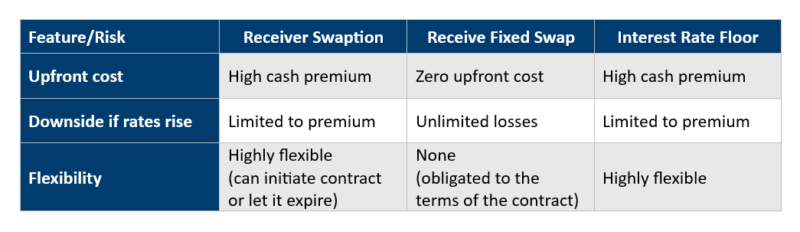
Conclusion
If your interest rate risk reports indicate that a sharp decline in market interest rates could reduce your institution’s earnings and the estimated reduction exceeds policy limits, you may consider implementing one or more of the derivative strategies discussed in this blog. Carefully consider the risks and rewards of each strategy to determine which works best for you.
Learn how UMB Bank Capital Markets Division’s fixed income sales and trading solutions can support your bank or organization, or contact us to be connected with a team member.
When you click links marked with the “‡” symbol, you will leave UMB’s website and go to websites that are not controlled by or affiliated with UMB. We have provided these links for your convenience. However, we do not endorse or guarantee any products or services you may view on other sites. Other websites may not follow the same privacy policies and security procedures that UMB does, so please review their policies and procedures carefully.
Disclosure:
This communication is provided for informational purposes only. UMB Bank, n.a. and UMB Financial Corporation are not liable for any errors, omissions, or misstatements. This is not an offer or solicitation for the purchase or sale of any financial instrument, nor a solicitation to participate in any trading strategy, nor an official confirmation of any transaction. The information is believed to be reliable, but we do not warrant its completeness or accuracy. Past performance is no indication of future results. The numbers cited are for illustrative purposes only. UMB Financial Corporation, its affiliates, and its employees are not in the business of providing tax or legal advice. Any materials or tax‐related statements are not intended or written to be used, and cannot be used or relied upon, by any such taxpayer for the purpose of avoiding tax penalties. Any such taxpayer should seek advice based on the taxpayer’s particular circumstances from an independent tax advisor. The opinions expressed herein are those of the author and do not necessarily represent the opinions of UMB Bank or UMB Financial Corporation.
Products, Services and Securities offered through UMB Bank, n.a. Capital Markets Division are:
NOT FDIC INSURED | MAY LOSE VALUE | NOT BANK GUARANTEED