The second quarter brought a rapid rebound from the turbulence unleashed during Q1. Markets had fallen during Q1 in response to the Iraq conflict, but began to rebound in early April, maintaining that momentum through the end of June.
The Iran conflict brought turbulent headlines throughout the second quarter, with “on again, off again” reports around potential peace treaties hitting the news (which continues as we write this update). Some green shoots of positive momentum began to show up in the previously anemic labor market data, while issues with K-shaped growth and consumption patterns persisted.
Perhaps most importantly, Kevin Warsh was confirmed as the new chair of the Federal Reserve (Fed) and was sworn into office in mid-May. His first meeting and follow-up comments marked a potential turning point in the Fed’s approach to managing the economy. However, with a potential resolution of the Iran conflict, combined with stellar earnings reports from Wall Street, the equity markets powered forward, generating robust gains.
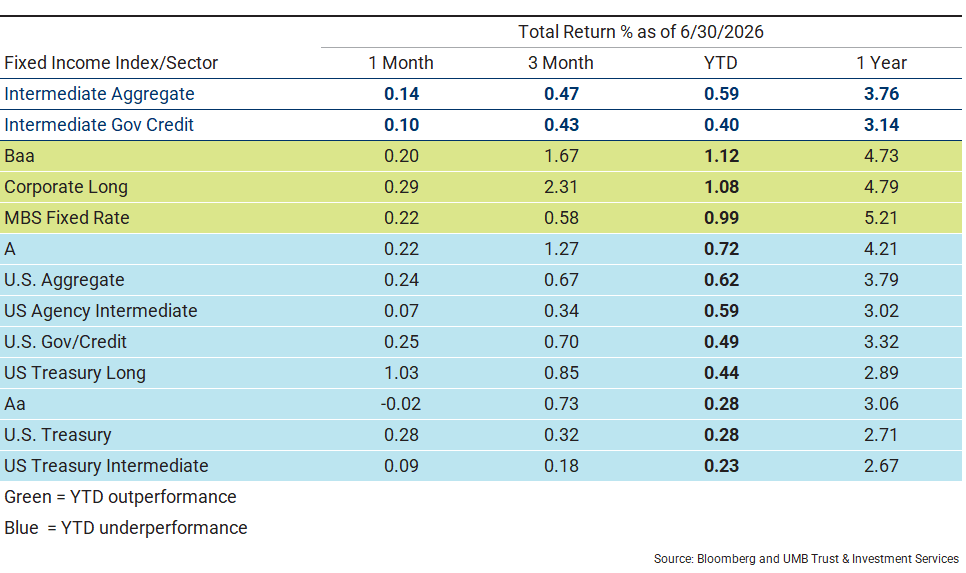
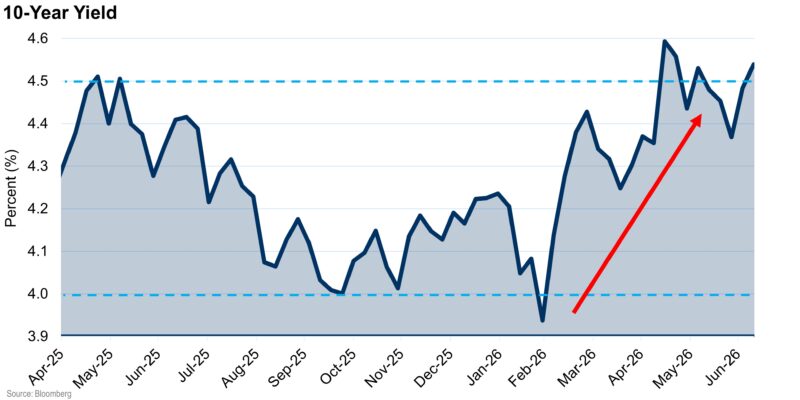
By the end of June, the S&P 500 had rebounded +15% for the quarter, driving year-to-date (YTD) returns to +10%. Stubborn Inflation data and stern language from the Fed sent interest rates higher again, leaving YTD returns in the bond market at only +.34% (intermediate investment grade*).
Kevin Warsh initiates a new era for the Federal Open Market Committee (FOMC)
Warsh’s nomination was a surprise to many analysts, because his view of the Fed’s role wasn’t aligned with the current administration’s. He has traditionally indicated a more “hawkish” view toward interest rate and balance sheet management (and he’s an out-spoken opponent of quantitative easing). In simple terms, he has been in favor of more aggressive enforcement of the Fed’s 2% inflation target and has been opposed to having the Fed purchase government bonds to help push rates lower (boosting the economy). Both of these views run counter to the more accommodative style of the last few Fed chairs.
Shortly after taking office, Warsh made it clear that he intends to initiate a transformation in the way the Fed operates. He has appointed several task forces to formulate strategic changes in several key areas:
- Communication: It appears that under his leadership, the FOMC will be much less transparent. He seeks to move toward significantly less “forward-guidance,” diverging from the norm of the past few decades.
- Balance sheet policy: At this time, Warsh seems intent on shrinking the size of the Fed balance sheet, which could put upward pressure on interest rates, as the Fed releases bond holdings into the open markets.
- Data sources: The Fed will seek to obtain more data from private (non-government) sources, hoping to find more “real time” feedback on the condition of the U.S. economy.
- Productivity/Jobs: The Fed will investigate how technology impacts the labor market and the overall economy.
- Inflation framework: Warsh is interested in assessing different measures of inflation and perhaps changing the way the Fed reacts to changes in the data. “We will deliver price stability” was the clear theme of Warsh’s first FOMC meeting – a crystal-clear commitment to lower inflation to 2%.
We are in the very early stages of this transition, but Warsh will likely bring many changes to the Fed. The markets will have to adapt to less communication from the FOMC and will no longer be able to assume that the Fed will immediately respond to every crisis with a quick injection of “interest rate relief.” Also, tougher talk on inflation and balance sheet management could result in higher interest rates over the upcoming cycle. It is fair to assume this new environment could include higher market volatility during times of uncertainty. All these new assumptions have been digested by the markets, seemingly without any fanfare.
The Iran war and the oil impact continue
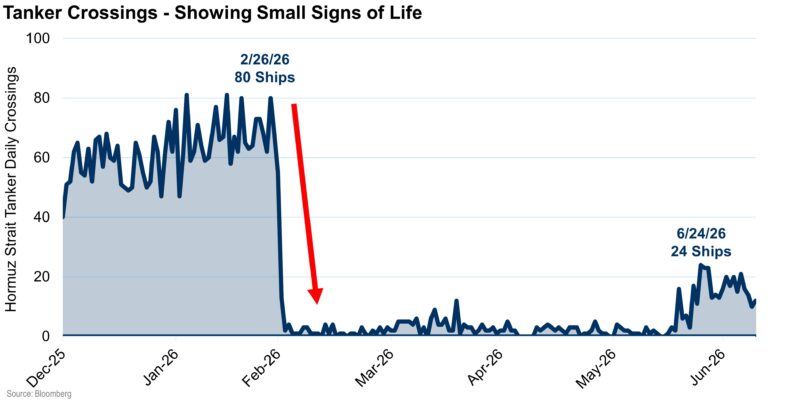
After a turbulent period of brinkmanship by both sides, the quarter closed with what appeared to be a tenuous cease-fire agreement with Iran. Ships have begun to move through the Strait of Hormuz, albeit in much reduced numbers relative to history. The oil market has positioned for a full return to normal, with futures falling back into the mid-$70 a barrel range — nearly back to the price levels from before the conflict. Gasoline prices have fallen dramatically from their highs, taking some pressure off consumers.
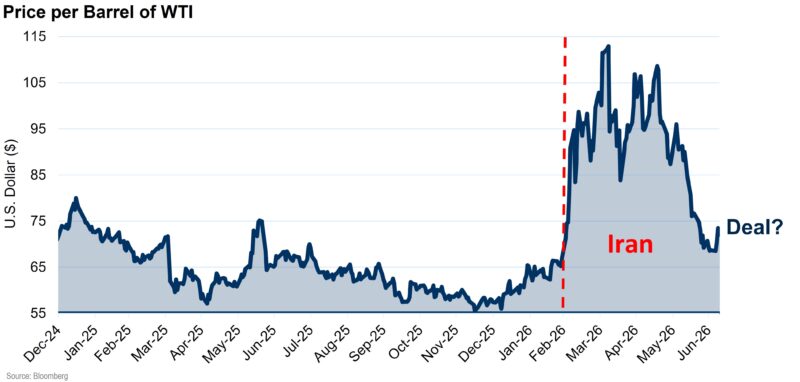
Stabilization of the energy market should help take pressure off the inflation data over coming months. There is a possibility that Iran does not intend to meet U.S. demands, creating the risk of re-escalation. But, at this time, the energy and financial markets have rebounded and are positioned for a lasting resolution that will remove pressure from the global economy.
Inflation is stuck
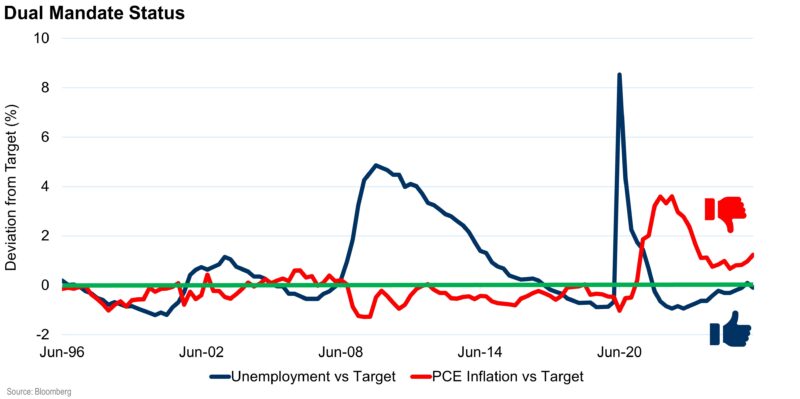
Inflation was already stuck well above the Fed target before the Iran crisis erupted. The disruption to global energy supply put more upward pressure on most measures of inflation. As the second quarter closed, headline inflation readings (including energy) had pushed to well above 4% (versus a Fed target of 2%). Core measures (excluding energy) had risen to 3% or higher.
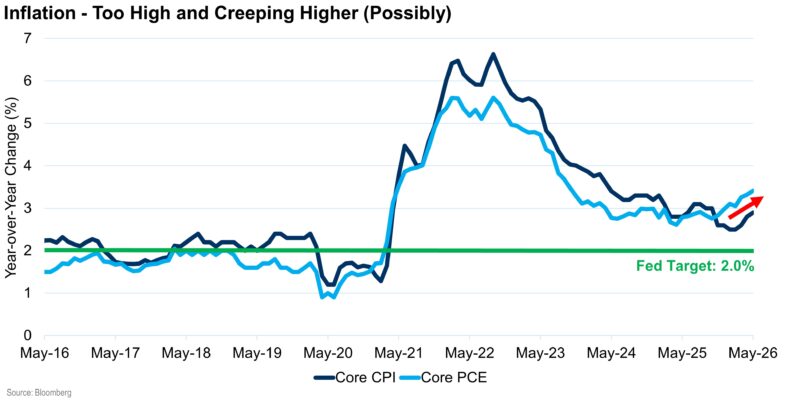
If an agreement with Iran is finalized and traffic through the strait is normalized, falling energy prices should ease pressure on most measures of inflation throughout the back half of the year, which is reflected in most Wall Street forecasts. Recently, however, heavy demand from data center construction has boosted prices in the tech space, which could continue to put upward pressure on some measures of inflation for the next several months. We may have offsetting trends pushing inflation in both directions for a while—keeping inflation “sticky” at current levels into next year.
There is a great deal of uncertainty around inflation, and the FOMC has made it clear that all discussions of lower rates have ended. They intend to stay on hold until more data is gathered to confirm that inflation is expected to move sustainably lower. In fact, the futures markets for fed funds currently reflect rate increases in early 2027. What we know with certainty is that the outlook for inflation is highly debatable over the shorter term. Consequently, longer-term interest rates are unlikely to move meaningfully lower over the short to intermediate term.
Economic momentum and GDP
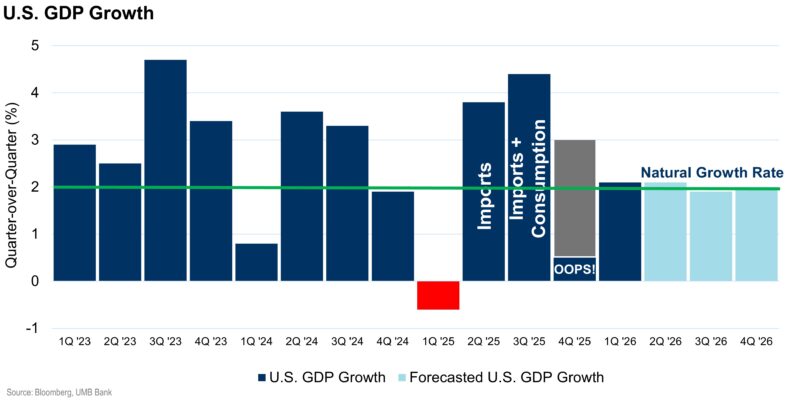
Despite the ongoing global disruptions, the U.S. economy continues to move forward at a very normal growth rate, right around 2% (annualized). Consumption continues to be surprisingly robust (although driven primarily by higher-income households). If oil prices stabilize at lower levels, we would expect gross domestic product to finish 2026 at 2% or possibly higher.
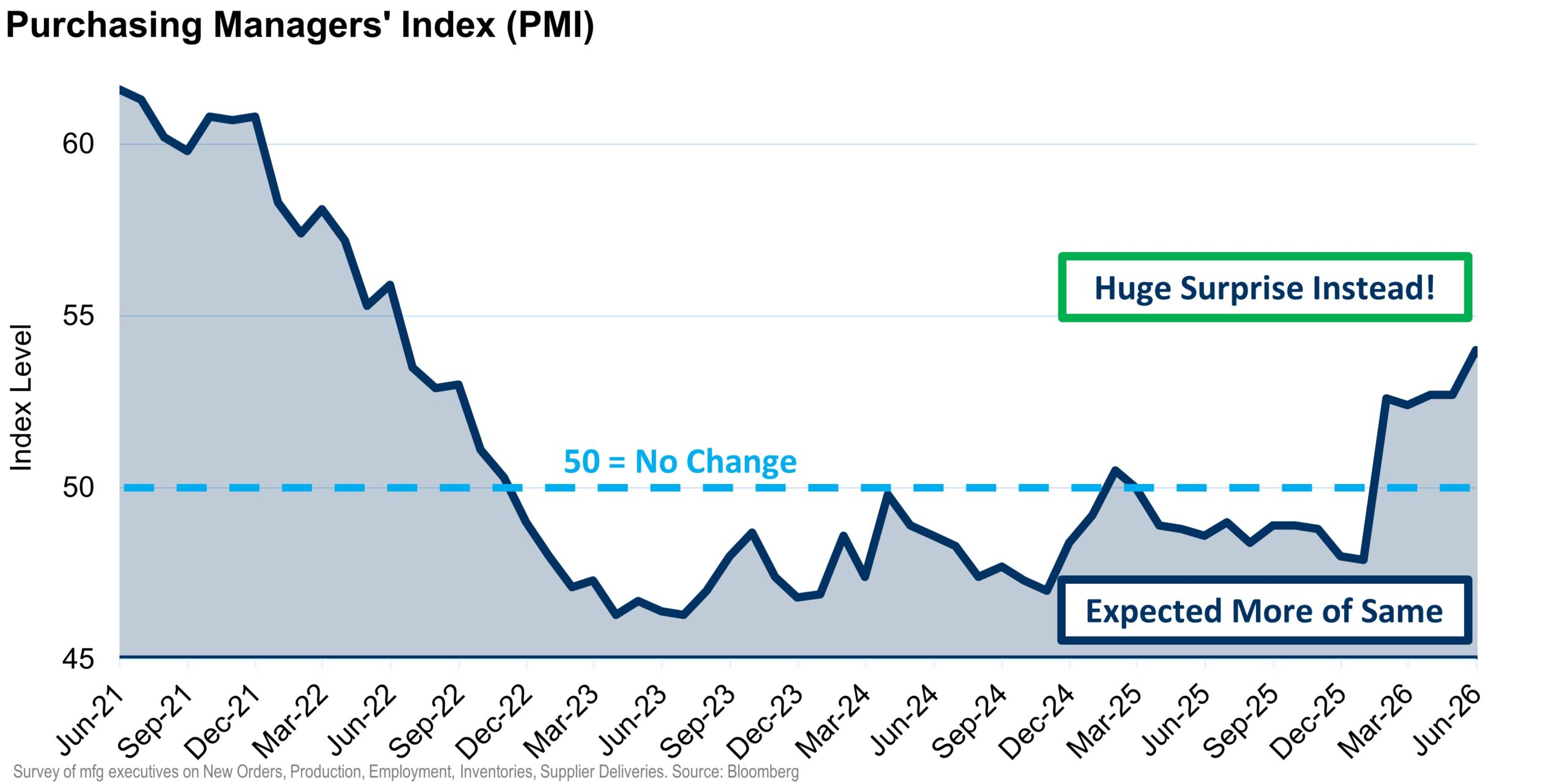
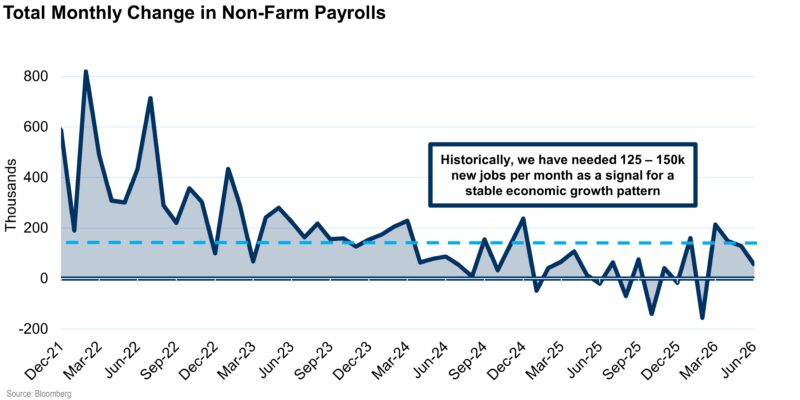
The labor market has shifted in a much more positive direction, with payroll growth posting a strong rebound over recent months. Additionally, jobs growth is recovering in some key manufacturing spaces (away from tech), which signals better job and wage growth across a good portion of the economy. Consumer sentiment surveys continue to look weak, but should be bolstered by an improving job market.
Wealth effect, K-shaped issues and consumption
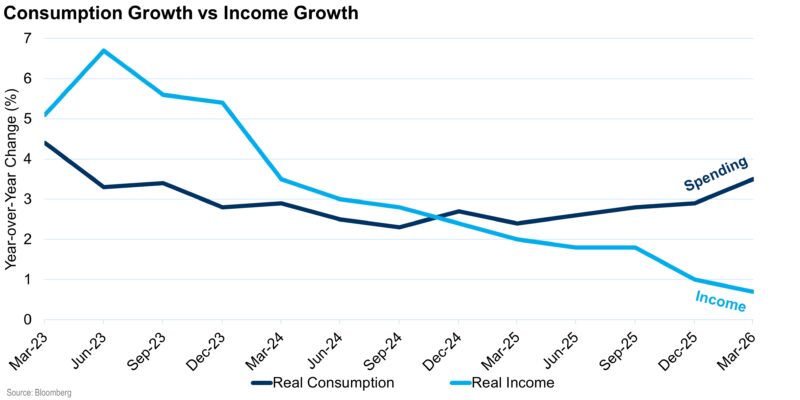
The noise around the K-shaped economy persists and will likely continue to be a focus of the media for the foreseeable future. As the equity market continues to push higher, the distance between the top and bottom households continues to widen. Nearly 90% of equity ownership resides within the top 10% to 20% of households (by income). Wealth expansion and income growth appear to be driving very strong consumption patterns amongst the wealthiest households in the U.S.
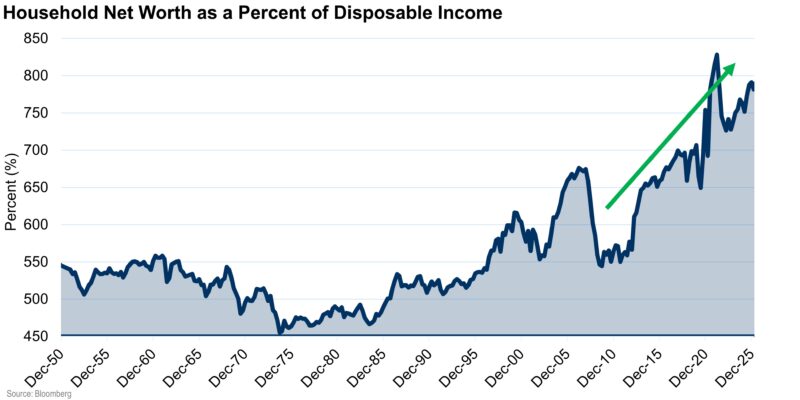
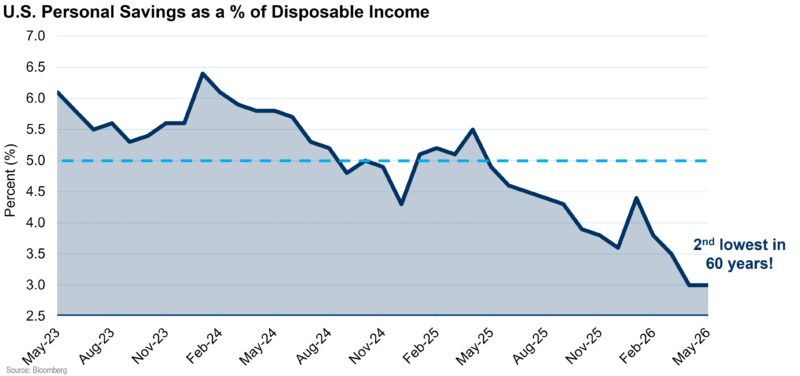
This leaves the FOMC with a challenging combination of patterns to address. Heavy consumption amongst wealthy households, plus robust capital spending in the business space, are inflationary pressures in many ways, which call for higher interest rates. Conversely, the struggles of the middle- and lower-income households point toward a need for lower interest rates.
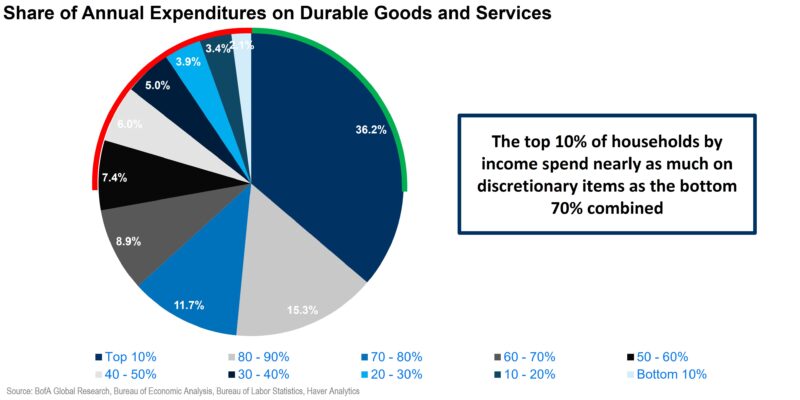
At this time, the FOMC is more concerned with inflation, which portends steady to higher rates for the time being. But there is building political pressure to focus on the struggles of middle- and lower-income households. The K-shaped economy will provide an ongoing challenge for the new Fed regime.
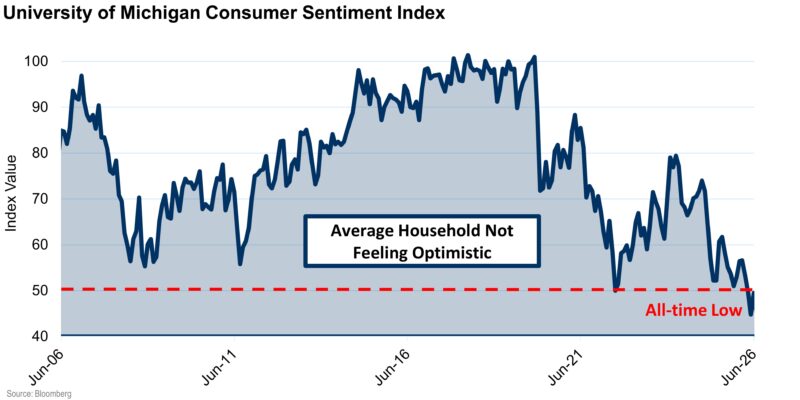
Resilient markets
The U.S. stock and bond markets have continued to display amazing resilience in the face of high levels of global uncertainty. First-quarter earnings were stellar, with average S&P 500 earnings surpassing forecasts by about 20%. Profit margins are at all-time highs and the outlook for earnings growth over the coming year is robust.
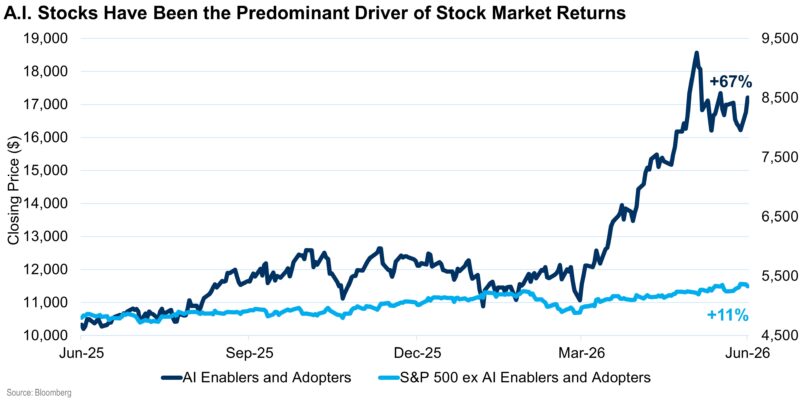
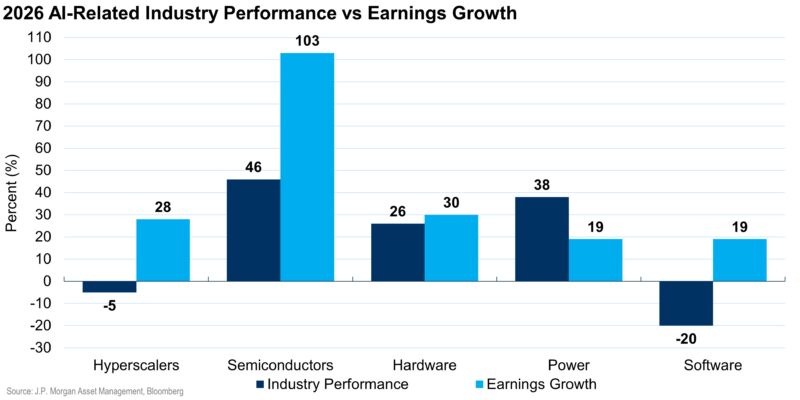
The hyperscaler (server farm) buildout continues to drive massive capital expenditures throughout the economy. Earnings growth within the S&P 500 is heavily tilted toward the tech space, and the trend is expected to extend through 2027. CEO surveys indicate high levels of optimism throughout most industry sectors, which should help bolster job and wage growth heading into 2027 (which will help those in lower-income groups). We are cautiously optimistic about the encouraging signs coming from the labor market and CEO surveys and expect the equity markets to deliver reasonably strong returns over the short to intermediate term.
International markets have experienced rolling spots of volatility thus far in 2026 but have posted strong overall returns since the onset of the cease-fire with Iran. The international market (excluding the U.S.) posted a huge rebound in the second quarter, pushing 2026 YTD returns up 11.65%. The changing Fed regime could be changing the outlook for the U.S. dollar (in a positive direction), so we have elected to reduce our overweight position in international assets, tilting our holdings back in favor of the U.S.
Risks to the economic outlook
The first and most obvious risk to our moderately optimistic outlook would be a long-term resumption of armed conflict with Iran. It is impossible to assign a precise probability to this scenario, but we believe all parties involved need the treaty to hold and the strait to return to normal traffic flow. We believe there is a low likelihood of a resurgence of lasting military conflict.
As we write this summary, there is resurgence of conflict in the area, because of issues with Iran’s willingness to comply with our proposal. It’s a fluid situation, but all parties have meaningful economic and political incentives to find a lasting solution. There are some global strategists that believe a persistent conflict will re-accelerate in future months, but we are not in that camp at this time.
The second meaningful risk to the outlook is the possibility of persistent inflation. It is presumed that lower oil prices will help inflation begin to drop back towards the Fed target of 2% naturally, without any need for the Fed to hike rates. However, recent surges in pricing within the tech space have some analysts concerned that inflation could prove to be stickier than is currently reflected in the markets. We noted earlier that fed funds futures reflect modest hikes to interest rates early next year — presumably to reflect the risk of stubborn inflation. It seems unlikely that tech prices will continue to rise for an extended period, as competitive supply is already flowing into most sectors. But tight supply could keep prices rising over the shorter term, causing inflation to crest later than many are hoping. Inflation may prove to be more stubborn than many hope, but we believe this will prove to be a shorter-term issue. We currently expect inflation to fall by early 2027 at the latest.
Concluding thoughts
We are cautiously optimistic that the outlook for global growth and earnings is positive as we head towards 2027. We expect normal GDP growth (around 2%) and normalizing inflation rates (falling toward 2%) as we close 2026.
The capital markets have delivered extremely handsome returns already in 2026 and equities may move sideways through the remainder of the year. Looking ahead at 2027, both the economy and markets appear to be poised for reasonable growth rates. Consequently, we are slightly overweight in equities, with that overweight focused in U.S. midcap equities. We expect the Fed to remain on hold well into 2027, but then falling inflation rates should soften their tone as 2027 unfolds. Longer-term interest rates may not fall much from current levels (10-year Treasury rates around 4% to 4.5%) because of the many uncertainties around inflation, the deficit and the new Fed regime.
Global equity markets have adapted quite quickly to the new narrative from Warsh. What remains to be seen is how the markets will react when the next unsettling macroeconomic event shows up, and there is no quick, supportive reaction or commentary from the FOMC. For more than 20 years, the markets have benefited from highly accommodative Fed chairs and high levels of forward guidance. We will now all need to learn how to navigate the financial markets with neither of those privileges. Higher volatility should be expected, but the overall outlook should remain constructive.
Follow UMB‡ on LinkedIn to stay informed of the latest economic trends.
When you click links marked with the “‡” symbol, you will leave UMB’s website and go to websites that are not controlled by or affiliated with UMB. We have provided these links for your convenience. However, we do not endorse or guarantee any products or services you may view on other sites. Other websites may not follow the same privacy policies and security procedures that UMB does, so please review their policies and procedures carefully.
Sources for this report are from internal UMB data, Bloomberg, BofA Global Research, Bureau of Economic Analysis, Bureau of Labor Statistics, J.P. Morgan Asset Management and Haver Analytics.
*Intermediate investment grade bonds are fixed-income securities that mature in roughly 3 to 10 years and carry high credit ratings indicating a low risk of default. They blend the steady income of bonds with moderate protection against interest rate shifts.
Disclosure and Important Considerations
This report is provided by UMB Trust & Investment Services a division of UMB Bank, n.a. for informational purposes only and contains no investment advice or recommendations to buy or sell any specific securities. Statements and projections in this report are based on the information provided by the client or third parties, and available as of the date this report was published. UMB Trust & Investment Services obtained information used in this report from third-party sources it believes to be reliable, but this information is not necessarily comprehensive, and UMB Trust & Investment Services does not guarantee that it is accurate. All investments involve risk, including the uncertainty of dividends, rates of return and yield and the possible loss of principal. Past performance is no guarantee of future results.
The S&P 500 Index is unmanaged, consisting of a market capitalization-weighted index of 500 common stocks. It is not possible to invest directly in an index.
You should not use this report as a substitute for your own judgment, and you should consult with professional advisors before making any tax, legal, financial planning or investment decisions. This report contains no investment recommendations, and you should not interpret the statements in this report as investment, tax, legal, or financial planning advice.
Neither UMB Trust & Investment Services nor its affiliates, directors, officers, employees or agents accepts any liability for any loss or damage arising out of your use of all or any part of this report.
“UMB” — Reg. U.S. Pat. & Tm. Off. Copyright © 2026. UMB Financial Corporation. All Rights Reserved
Securities offered through UMB Private Wealth Management, LLC (UMBPWM), an SEC registered investment adviser, UMB Financial Services, Inc. (UMBFSI), member FINRA, SIPC, a broker dealer and SEC registered investment adviser, UMB Trust & Investment Services, a division within UMB Bank, n.a., and UMB Bank, n.a. Capital Markets Division, a separately identifiable division of UMB Bank, n.a. and an SEC registered municipal securities dealer.
Banking services offered through UMB Bank, n.a.
Insurance products offered through UMB Insurance, Inc.
UMBPWM, UMBFSI, UMB Bank and UMB Insurance are affiliates and wholly owned subsidiaries of UMB Financial Corporation.
You may not have an account with all of these entities. Contact your UMB representative if you have any questions.
SECURITIES AND INSURANCE PRODUCTS ARE:
NOT FDIC INSURED • NO BANK GUARANTEE • NOT A DEPOSIT
NOT INSURED BY ANY GOVERNMENT AGENCY • MAY LOSE VALUE