
So-called ’34 Act funds are of increasing interest to asset managers, based on our conversations with clients planning future fund launches. Funds of this structure are purpose-built to accommodate scale—without the portfolio constraints imposed by the ’40 Act.
In our experience, asset managers are considering ’34 Act funds to bridge a gap between:
- Traditional private funds, which have broad portfolio latitude but a limited investor count.
- ’40 Act registered funds, which have substantial portfolio constraints and an unlimited investor count.
In recent years, asset managers have successfully brought many strategies from the private funds space into the retail space, thereby reaching a far broader audience. Semi-liquid offerings such as interval funds and tender-offer funds epitomize this “retailization” theme.
But there are other ways to scale, and one is to maintain the focus on accredited investors and qualified purchasers but without a cap on the total number of investors. That’s where ’34 Act funds come in.
From an asset manager’s perspective, ’34 Act funds offer the potential for substantial scale, often through feeder arrangements. From an investor’s perspective, they offer considerably more transparency than traditional private funds and, typically, somewhat greater liquidity. Therefore, this “middle ground” has emerged as a prime product-development focus in strategies including private equity, real estate, and infrastructure.
When asset managers inquire about ’34 Act funds, conversation turns quickly to substantially greater filing demands in comparison to traditional private funds. ’34 Act funds are registered under the ’34 Act, whereas traditional private funds rely on an exemption under section 3(c)(7) of the ’40 Act. So, while the phrase “private registered fund” might initially sound like a mistake, it isn’t.
How ’34 Act funds fit in
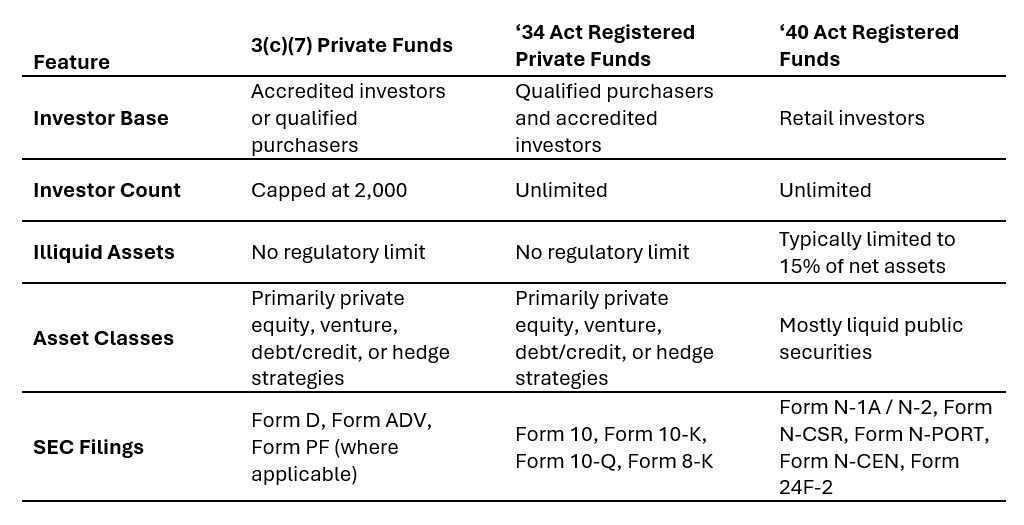
The following table puts ’34 Act funds in context with the two ends of the spectrum, both of which are more familiar to most industry participants than the middle ground asset managers are now exploring.
Administration services for ’34 Act funds
In the preceding table, note the substantially different set of filings, starting with Form 10, which are more familiar to corporate finance professionals than to most investment industry professionals. These filings illustrate one way in which the ’34 Act structure is not simply a “scaled up” private fund.
Electing to register a class of securities under the ’40 Act introduces a public-company reporting regime, including periodic reporting, disclosure controls, and governance considerations that are unfamiliar to many private fund sponsors. As a result, the operational demands are materially different from those of a traditional private fund and are central considerations in managers’ product-development processes.
Part of our focus at UMB is to make the filing process as efficient as possible, working in close collaboration with our clients’ other service providers. We also work to help remove operational obstacles to achieving scale—through both technology (UMB’s proprietary AltPro system) and people (structured in teams with specialists who understand the full range of a fund’s assets and lifecycle).
Learn more about UMB Fund Services and how we can support your firm’s registered and alternative investment fund servicing needs, or contact us to be connected with a fund services team member.