As we prepare for the latter half of the 2020s, we’re keeping a close eye on conflicting signals from employment, inflation and gross domestic product (GDP)—two of which are in the mid-4% range.
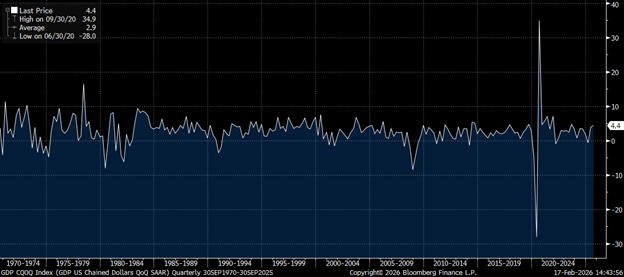
The U.S. Bureau of Economic Analysis‡ (BEA) reported the economy grew at an annualized rate of 4.4% in the third quarter of 2025, as measured by gross domestic product (GDP). To put the rate into historical context, while a 4.4% annualized GDP is strong, it does not stand out as an outlier. The third quarter’s GDP reading does not rank in the top 20% of all annualized quarterly readings since 1970, nor in the top 20% of all third quarter readings since 1970 or since 2000. It only crosses the threshold when considering all quarterly readings since 2000, ranking in the top 16.5%.
Economists and policymakers might find this number exciting precisely because of its “good-but-not-great” status: it does not signal malaise but could raise some concern about the economy overheating. However, the fourth-quarter BEA‡ advance estimate of 1.4% GDP growth further tempers some of that concern.
Source: Bloomberg
In a more recent context, the 4.4% annualized GDP data point nearly doubles the 2.3% average GDP since the start of the century. If we remove post-COVID skew, it more than doubles the 2000-2019 GDP. Clearly, onshoring and related manufacturing gains in the economy pose a challenge for bond market participants. Both the current and future yield curves determine bond yields, so conviction about where interest rates are and will be remains critical to broader market movements and to being well-positioned for them.
GDP this strong suggests the Federal Reserve Board‡ (Fed) may remain on hold even longer than it did following cuts in 2024 and 2025—a notion backed by the hawkish tone in the January FOMC Meeting Minutes‡. If GDP data continues to beat estimates, determining the post-COVID neutral rate becomes even more important. Productivity data alone allows the Fed to enjoy its role as a monetary policymaker, specifically giving it substantial time to keep rates high and focus on squeezing unwanted inflation from a money-supply-infused economy. Fixed-income investors should remain wary of putting too many eggs in the “rates down” scenario basket.
How much certainty can we have when forecasting future interest rates?
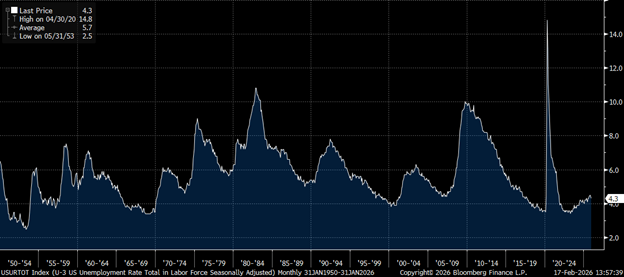
Though productivity remains surprisingly strong, if labor market strains prompt the Fed to ease in the near future, as they did this past fall, they may once again overreact and then feel compelled to hike. With the U-3 unemployment rate near 4.4%, policymakers must carefully coordinate monetary policy. For much of the past 20 years, the U-3 rate trended above 4%, partly because the participation rate shrank. But, once the post-COVID economy opened up, this rate trended well below 4% until June 2024. Since the rate rose above 4% in June 2024, and especially amid recent immigration-related supply and demand shocks, the Fed has vigilantly protected the labor market, citing this as its rationale for repeatedly easing in 2025.
For this data set, 4.4% represents a trough rather than an elevated level over the last 75 years, especially since the labor force participation rate began expanding in the 1970s.
Source: Bloomberg
Unemployment has clearly increased from post-COVID lows, but the rate has not yet experienced the sharp spike it typically shows during times of economic stress. Because of the K-shaped recovery, one might ask, “Why should it, with no economic stress to speak of?” Interestingly, recent U.S. history shows few periods when the unemployment rate rises slowly and in an orderly manner.
Historically, the unemployment rate takes the elevator up and the escalator down, while interest rates do the exact opposite (escalator up, elevator down, often reacting to a sharp economic downturn). Indeed, the chart below provides few examples over the last 75 years of unemployment rates rising out of a trough and trending higher in an orderly fashion for any extended period. Have we turned a corner, and are we poised for further gains in the labor market? Could artificial intelligence’s (AI) impact on the labor market drive these gains? This unique positive slope may reflect the gradual adoption of AI. Or will we see an accelerated move higher?
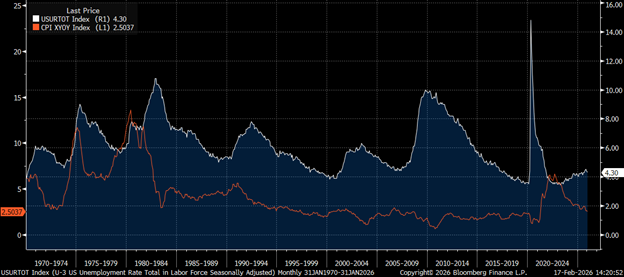
Consider one other classic trend: the correlation between unemployment and inflation. As inflation continues to trend lower and unemployment creeps higher, a stronger GDP seems out of step with the two pillars of the Fed’s dual mandate. Will productivity and efficiency gains continue to drive GDP’s outperformance? How vulnerable are labor markets to any sustained move lower in GDP, even if weaker results don’t cause an outright recession? We will be watching these factors closely as we look ahead.
Source: Bloomberg
Preparing your balance sheet
We expect AI to generate productivity tailwinds going forward, and many writers have extensively discussed the forthcoming productivity boom. Will those gains materialize? Are we approaching an inflection point where AI negatively impacts labor markets?
This unique challenge of strong productivity gains and a weakening labor market may keep the fixed-income market range bound and anchored by the next Fed movement for some time. Thankfully, the yield curve is steepening, with a 10-2 trending between 60-70 basis points (bps), and the recurring repricing of treasuries supports the thesis that longer duration rates will retain a positive slope. Yet, we know bond yields tend to increase gradually and drop precipitously. So, although this mantra is well known for a reason, it bears repeating.
Prepare your balance sheet for both a rates-up and rates-down shock. Fed Chair nominee Kevin Warsh‡ may begin his term with more inflation-fighting enthusiasm than Powell’s last two years, while at the same time, labor weakness could indeed signal a looming recession.
Protecting against declining rates
Specifically, on earning assets, you can protect against declining rates by booking duration with staying power through either extending call protection or lowering coupons. You can guard against rising rates by filling in the neglected cash flow buckets in the 2028-2030 maturity distribution. For liabilities, you only need to review the 2023-2024 spread to warrant laddering a portion of your core and wholesale deposits over a 2- to 5-year time frame. This approach protects you against a sudden return to higher rates, rather than the more common 0-18 months, which nearly immediately reprices when rates drop.
If you want to learn more about these strategies, our team is here to help. The first step in the process is speaking with your UMB representative about the best option for your bank. Learn how UMB Bank Capital Markets Division’s fixed income sales and trading solutions can support your bank or organization, or contact us to be connected with a team member.
About the authors:
Stephen DuMont joined UMB Bank, n.a. Capital Markets in 2007. Stephen is a senior vice president and investment officer responsible for serving institutional clients regarding interest rate risk management and fixed-income portfolio strategies. Stephen brings over 20 years of financial experience to the UMB team.
Winston Crowley joined the UMB Bank, n.a. Investment Banking Division in 2014 and has worked in the financial industry for 20+ years. As senior vice president covering the Colorado and western markets, Winston is responsible for consulting with institutional clients on the management of their fixed-income portfolios. He also leads UMB’s sales effort for FX and the Marketable Securities Reverse Repo program.
Matthew Wolczko joined the UMB Bank, n.a. Investment Banking Division in 2021. As a Vice President, Investment Officer covering the state of Texas, Matthew is considered a fixed-income specialist, responsible for soliciting new community bank and institutional client relationships. His specialties are balance sheet analysis and sales of fixed-income products.
When you click links marked with the “‡” symbol, you will leave UMB’s website and go to websites that are not controlled by or affiliated with UMB. We have provided these links for your convenience. However, we do not endorse or guarantee any products or services you may view on other sites. Other websites may not follow the same privacy policies and security procedures that UMB does, so please review their policies and procedures carefully.
Disclosure:
This communication is provided for informational purposes only. UMB Bank, n.a. and UMB Financial Corporation are not liable for any errors, omissions, or misstatements. This is not an offer or solicitation for the purchase or sale of any financial instrument, nor a solicitation to participate in any trading strategy, nor an official confirmation of any transaction. The information is believed to be reliable, but we do not warrant its completeness or accuracy. Past performance is no indication of future results. The numbers cited are for illustrative purposes only. UMB Financial Corporation, its affiliates, and its employees are not in the business of providing tax or legal advice. Any materials or tax‐related statements are not intended or written to be used, and cannot be used or relied upon, by any such taxpayer for the purpose of avoiding tax penalties. Any such taxpayer should seek advice based on the taxpayer’s particular circumstances from an independent tax advisor. The opinions expressed herein are those of the author and do not necessarily represent the opinions of UMB Bank or UMB Financial Corporation.
Products, Services and Securities offered through UMB Bank, n.a. Capital Markets Division are:
NOT FDIC INSURED | MAY LOSE VALUE | NOT BANK GUARANTEED