
Institutional investors and asset managers may need to update their 2026 plans to match the tremendous shifts seen so far on the global stage and in domestic markets. While it seems the U.S. economy is still advancing and forecasters are optimistic, it’s prudent to evaluate your trade strategy to assume a defensive position – just in case.
Inflation hits energy, fertilizer
In the past few years, inflation has drifted downward and seemed to have settled in the 2-3% range—that is, until the U.S.-Iran War began. The war has driven inflation mainly by closing the Strait of Hormuz, which constrained global oil supply and pushed West Texas Intermediate (WTI) crude oil prices‡ to more than $100 per barrel, up from $62 in February. Commercial traffic through the strait has dropped by 90%, creating fuel shortages and drastically increasing fertilizer costs.
Before this war, approximately 20%-30% of global fertilizer exports transited the strait, including about 23% of ammonia and 34% of urea, the most widely used nitrogen-based fertilizers. Prices vary by location, but in March, Illinois saw average urea prices increase by 42% and average ammonia prices increase by 18.5%‡.
This increase in fuel prices is affecting nearly all industries, with the national average price of gasoline currently hovering around $4.50 per gallon. Consumers and producers alike feel the pressure of higher fuel prices, and ongoing inflation data reflects this impact. High fertilizer prices threaten food production for billions of consumers worldwide, further contributing to higher inflation for U.S. consumers across daily needs.
As inflation fears mount, investors are selling off U.S. Treasury bonds, pushing the 30-year bond to its highest level since 2007.
High costs squeezing consumers
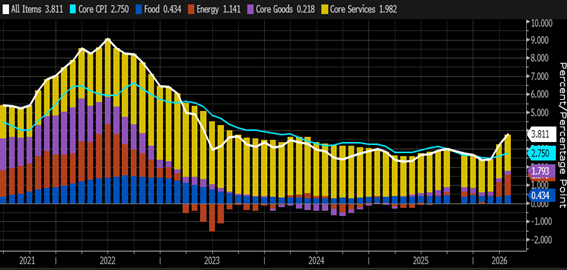
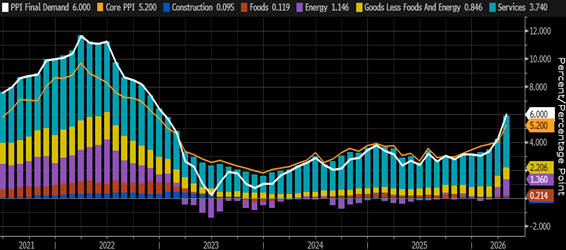
In May, the Bureau of Labor Statistics released Consumer Price Index‡ (CPI) and Producer Price Index‡ (PPI) figures for April. Both inflation gauges came in much hotter than expected. CPI increased 3.8% year over year, and PPI surged 6.0% year over year. When you dig into the data, you can see energy drove a substantial increase in both figures. Energy contributed 1.14% of the total CPI increase and 1.15% of the total PPI increase.
Energy is not the only category gaining steam; grocery prices rose 0.7% in April, the largest increase in nearly four years. The collective pressure of high food prices and rising fuel costs means consumers are feeling the financial pinch.
As you can see in the 5-year CPI chart below, inflation has trended up since the war with Iran began.
Source: Bloomberg
The 5-year PPI chart below shows the same trend, albeit at a sharper rate.
Source: Bloomberg
Trade ideas to combat market upheaval
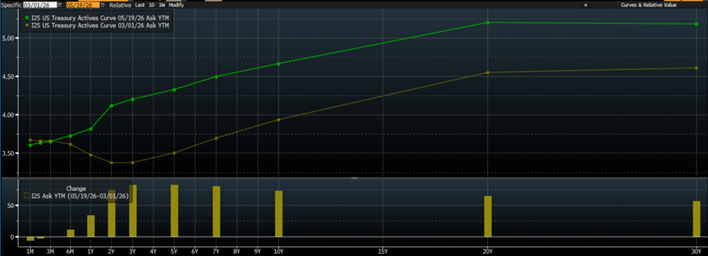
Before the Iran conflict began to affect the market, we saw rates rise noticeably and a bear flattener‡ form across the curve. The spread between 2-year and 10-year Treasuries narrowed by roughly 10 basis points, from about 60 basis points to 50 basis points. The 30-year long bond, which has historically served as our best gauge of inflation, rose nearly 60 basis points, and yields sold off to some of the highest levels in the past 25 years as prices and yields move inversely.
Source: Bloomberg
Many banks that borrow and lend short-term have felt the squeeze in net interest margin, but a few securities options have gained popularity, at least relatively. Investors have most notably favored more defensive options that are short and of higher credit quality.
This is far from rocket science, but mortgage-backed securities (MBS) investors last year worried about buying higher-coupon bonds, even at a discount, because those bonds would “burn” or “flame out” too quickly when rates dropped. Not too long ago, forecasters expected four cuts in 2026, along with a dovish president, a new Fed chair, and a long-term trend of disinflation.
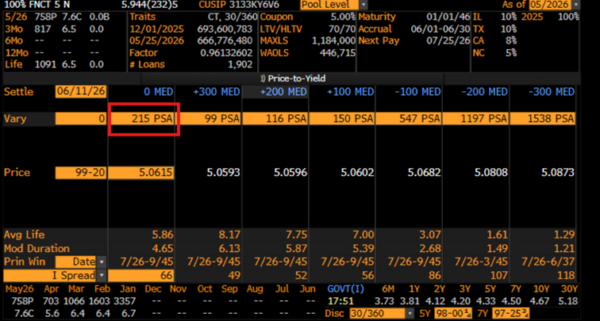
In our current market, the following graphic shows a popular trade of now slightly out-of-the-money, weighted-average coupon (WAC), 20-year, 5% agency pools. These currently project a 12% constant prepayment rate (CPR) for life, which is certainly cooler overall than before. These bonds, while having a longer final, look attractive in a higher-for-longer interest rate environment without any premium risk.
Source: Bloomberg
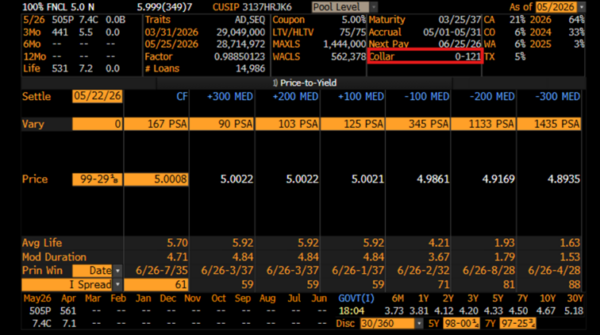
Another popular trade offers shorter, very accurately defined maturity (VADMs) bonds at a discount. This current offer features similar underlying collateral, a shorter overall hard final, and prepay “collars” that begin at 0 PSA/CPR to provide even more extension insurance within the structure of any extension risk.
As you can see below, even with a hypothetical parallel shift of 200 or 300 basis points to the upside, you still clip 5% to book, and, in these scenarios, your cash flow graph (CFG) remains exactly the same as long as it stays within the prepayment speed assumption (PSA) collars.
Source: Bloomberg
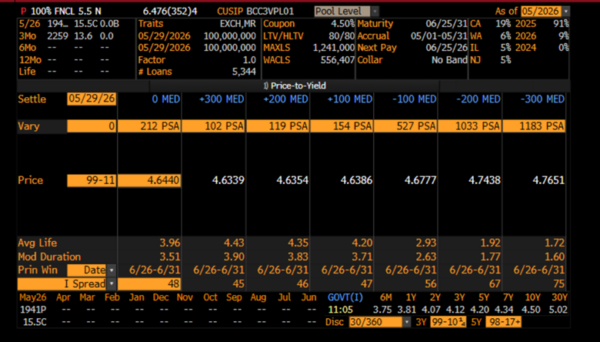
Along with shorter sequential collateralized mortgage obligations (CMOs) in general, the market has favored mandatory redemption structures as a defensive monthly cash flow product with shorter finals at discounts that can provide a favorable spread and yield.
The structure below pays like a sequential, with 30-year collateral as backing, a shorter coupon and yield in the base case, and a 5-year hard final.
Source: Bloomberg
Adjusting trades for a defensive market
The 2026 Iran conflict and the disruption of the Strait of Hormuz have reinforced how geopolitical instability can rapidly reshape inflation expectations, global trade dynamics, and financial markets. They have driven energy and fertilizer costs sharply higher and have reignited inflation just as markets had grown comfortable with expectations of rate cuts.
With CPI and PPI surprising to the upside, the long bond sitting near multi-decade highs, and the rate outlook now tilting toward hikes rather than cuts, the market is prudently taking a defensive posture.
Investors can use shorter-duration, higher-credit-quality structures with built-in extension protection (i.e., discount agency pools, collared VADMs, and mandatory redemption pools) to capture attractive carry without premium risk, position portfolios to weather a “higher for longer” environment, and preserve flexibility should conditions reverse.
Learn how UMB Bank, n.a. Capital Markets Division’s fixed income sales and trading solutions can support your bank or organization, or contact us to be connected with a team member.
About the authors:
Nick Meletio is senior vice president at UMB Bank, n.a. Capital Markets Division. Nick is responsible for investment portfolio strategies, fixed-income securities selection and asset-liability management.
Christopher Cronin is vice president at UMB Bank, n.a. Capital Markets Division. Christopher is responsible for helping customers manage and select investments that fall within the parameters of their investment policy.
When you click links marked with the “‡” symbol, you will leave UMB’s website and go to websites that are not controlled by or affiliated with UMB. We have provided these links for your convenience. However, we do not endorse or guarantee any products or services you may view on other sites. Other websites may not follow the same privacy policies and security procedures that UMB does, so please review their policies and procedures carefully.
Disclosure:
This communication is provided for informational purposes only. UMB Bank, n.a. and UMB Financial Corporation are not liable for any errors, omissions, or misstatements. This is not an offer or solicitation for the purchase or sale of any financial instrument, nor a solicitation to participate in any trading strategy, nor an official confirmation of any transaction. The information is believed to be reliable, but we do not warrant its completeness or accuracy. Past performance is no indication of future results. The numbers cited are for illustrative purposes only. UMB Financial Corporation, its affiliates, and its employees are not in the business of providing tax or legal advice. Any materials or tax‐related statements are not intended or written to be used, and cannot be used or relied upon, by any such taxpayer for the purpose of avoiding tax penalties. Any such taxpayer should seek advice based on the taxpayer’s particular circumstances from an independent tax advisor. The opinions expressed herein are those of the author and do not necessarily represent the opinions of UMB Bank, n.a. or UMB Financial Corporation.
Products, Services and Securities offered through UMB Bank, n.a. Capital Markets Division are: NOT FDIC INSURED | MAY LOSE VALUE | NOT BANK GUARANTEED