
The first quarter of 2026 witnessed a truly amazing mix of geopolitical and market events in rapid succession.
There were major global headlines throughout the first quarter, and, on the home front, the tariff package was struck down by the Supreme court, a new chairman of the Federal Open Market Committee (FOMC) was named, and the economy continued to struggle with labor market weakness and issues with K-shaped growth and consumption patterns.
There was also a frenzied, parabolic spike in the price of silver, which was at least partially attributed to a “debasement” move away from the U.S. dollar. Throughout this turbulence, the markets remained resilient, generating modest gains.
This held until the U.S. initiated military actions (along with Israel) against Iran, which changed everything. Open military conflict with Iran has been listed as a primary fear of most forecasters for quite some time, and the eruption of attacks sent a chill over market sentiment. Stock prices quickly moved lower and continued to deteriorate throughout March as the conflict escalated.
By the end of March, the S&P 500 had lost 5.00%, taking year-to-date (YTD) returns down to -4.35%. Since then, markets have rallied on news of negotiations, recovering to reasonable gains for YTD.
Rate cuts stymied
The war in Iran has quickly become the primary focus of the media and markets, largely because it immediately resulted in a closing of the Strait of Hormuz, shutting off roughly 20% of the global supply of oil. Oil prices spiked dramatically, rising nearly 70% in March. This has ignited concerns over upward pressure on inflation around the globe (with inflation in the U.S. already running well above Fed targets).
Hopes for two cuts to overnight rates evaporated and interest rates started to push higher. Many initially believed the conflict would end within a couple weeks, but it stretched through March and into April. The longer the conflict rages, the greater the pressure on inflation and interest rates, which is particularly severe in economies outside the U.S. If the closing or severe restriction of the Strait are prolonged, this will lead to “demand destruction” as higher costs for gasoline and anything containing petroleum products will presumably begin to crowd out purchases of other goods and services.
Inflation, consumer sentiment and the 2026 outlook rests on the Strait
A thorough discussion of all the potential risks of the Iran conflict is well beyond the scope of this update, but the conflict is now the primary factor affecting the economic and market outlook for the remainder of 2026. There were ongoing weaknesses within the U.S. economy before the Iran conflict erupted, and those issues persist, along with some encouraging hints of activity.
The bottom line: if the Strait of Hormuz‡ remains closed into late-May, it is likely that upward inflationary pressures and eroding consumer sentiment could cause a meaningful deceleration of economic activity around the world, potentially pushing us in the direction of a global recession. That said, this is not our expectation, but the risk is growing with each passing week the Strait stays closed.
In recent days, a tenuous cease fire was enacted, but military actions have continued. Markets have rebounded on hopes that negotiations will bring resolution in a timely manner. While an agreement could be reached at any moment, it appears unlikely that Iran will fully agree to the U.S.’s primary demands (which are to turn over their uranium stores and ensure that the Strait stays open). Therefore, we are prepared for these negotiations to remain choppy, with military flare-ups possible for months to come. The critical economic questions are when and how tanker traffic will be restored in the Strait. The futures market for oil continues to indicate that the Strait will open and prices will normalize within a few months.
Primary market themes to know
The U.S. stock and bond markets have been surprisingly resilient, given the breadth and magnitude of some of the geopolitical shocks that have occurred over recent months. As we write this update, markets have rebounded on the negotiation news and are near flat on a YTD basis. Even with all the potential economic impacts, GDP growth and earnings estimates remain healthy for 2026.
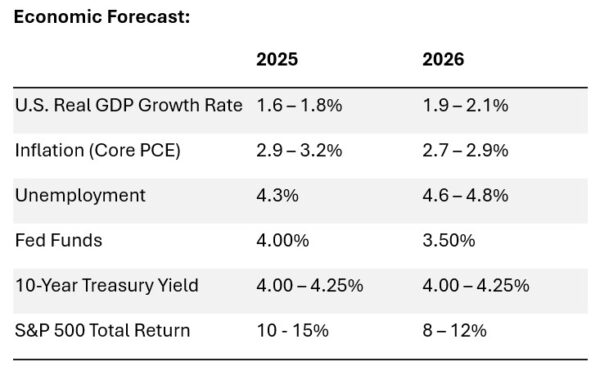
Market volatility will be high, and corrections in the normal range are possible (as much as -15%). But, at this time, we are still projecting 8-12% equity returns in the U.S. for 2026.
International markets have also rebounded smartly, generating positive returns thus far in 2026. Overall, global markets are anticipating a return to normalcy relatively soon and reasonable returns for the year.
- Inflation: Inflation has been stuck well above the Fed’s target, sitting near 3.00%. The spike in oil is certain to push inflation higher, likely to the 3.20-3.50% range, depending how long oil stays elevated.
- Economic momentum and GDP: Consumption continues to be surprisingly robust (although driven primarily by higher-income households). But, if oil spends another month above $90/barrel, U.S. GDP will likely drop by at least 40-50 basis points in 2026. However, the market would still experience growth, likely near our long-term average of 2.00% for the year, which is our current projection.
- Wealth effect, K-shaped issues and consumption: It is estimated that as much as 90% of equity ownership resides within the top 10% of households (by income). It also appears that income growth has been in favor of the wealthiest households over the last year. Wealth expansion and income growth appear to be driving very strong consumption patterns amongst the wealthiest households in the U.S.. This K-shaped economy has received high levels of attention within the media, as it points to potential imbalances in our economic system.
- Challenging economic and job data: Payroll growth in the U.S. slowed dramatically over the last 6-9 months, with monthly job gains averaging near zero for much of the last year. This is unusually weak job growth for the U.S. and signals difficult job prospects for those on the lower end of the income distribution. Job losses are not an issue yet, but job creation is exceptionally soft. Delinquency data continue to show signs of weakness and savings rates have fallen to near record lows. In aggregate, the average U.S. household is getting by but struggling to keep up with the rising cost of living. There are some encouraging signs in recent labor reports, but we need more confirmation over coming months to believe that this trend has reversed.
- The FOMC: The bond markets now project no cuts in 2026 and only one cut in 2027. This may be a bit pessimistic, as the oil market is projecting that prices will be falling throughout the remainder of 2026. For now, the Fed is on hold, awaiting signs that inflation will stop rising before they can begin discussing rate cuts again. If we are correct about oil and inflation falling later in the year, we foresee one rate cut, likely in the fourth quarter.
Economic outlook:
Our base case outlook calls for the Strait of Hormuz to be opened within a reasonable timeframe (less than 45 days), which will allow the global economy to steer clear of a meaningful, lasting slowdown.
In that environment, earnings growth should still be sufficient to support reasonably strong gains in the equity markets.
We believe the risk of global recession due to the conflict is well below 50%, likely around 30-35%. The capital markets clearly agree with this assessment. We are closely monitoring all news of the conflict and are tracking numerous data points for signs of a meaningful deterioration in the longer-term outlook.
The obvious risk to our market outlook is a prolonged clash that keeps the Strait closed well into the spring. If we reach May 28 with the Strait still closed, the war will have surpassed 90 days. If we haven’t achieved meaningful progress by then, we will become concerned about some of the worst outcomes coming to pass. In that event, inflation and interest rates could push meaningfully higher and GDP estimates would likely be lowered sharply.
Equity markets would almost certainly correct lower, to accommodate lower earnings expectations. If a global recession emerged, the market downturn could last longer than we’ve experienced in recent years (with no V-shaped recovery).
We do not believe this is the most likely outcome.
We are closely monitoring global events and will change our outlook if we see reason to believe that such a downturn is likely. We do not engage in market timing exercises like trying to dodge corrections and time V-shaped recoveries because we believe them to be virtually impossible to execute successfully. Rather, we seek to be fully invested when the intermediate outlook calls for expansion and seek to reduce risk exposure only when we believe the most likely outcome is a recession that could cause a deep, lasting downturn in the markets. Again, this is not our expectation for the next 12-24 months.
We are, for the time being, maintaining asset allocations in alignment with an outlook for positive economic and market outcomes in 2026.
When you click links marked with the “‡” symbol, you will leave UMB’s website and go to websites that are not controlled by or affiliated with UMB. We have provided these links for your convenience. However, we do not endorse or guarantee any products or services you may view on other sites. Other websites may not follow the same privacy policies and security procedures that UMB does, so please review their policies and procedures carefully.
Disclosure and Important Considerations
UMB Private Wealth Management is a division within UMB Bank, n.a. (a subsidiary of UMB Financial Corporation) that manages active portfolios for employee benefit plans, endowments and foundations, fiduciary accounts and individuals. UMB Financial Services, Inc. is also a subsidiary of UMB Financial Corporation and is an affiliate of UMB Bank.
This report is provided for informational purposes only and contains no investment advice or recommendations to buy or sell any specific securities. Statements and projections in this report are based on the opinions and judgments of UMB Private Wealth Management and the information available as of the date this report was published and are subject to change at any time without notice. Information used in this report is obtained from third-party sources believed to be reliable, but this information is not necessarily comprehensive, and UMB Private Wealth Management does not guarantee that it is accurate. All investments involve risk, including the uncertainty of dividends, rates of return and yield and the possible loss of principal. Past performance is no guarantee of future results.
You should not use this report as a substitute for your own judgment, and you should consult with professional advisors before making any tax, legal, financial planning or investment decisions. This report contains no investment recommendations, and you should not interpret the statements in this report as investment, tax, legal, or financial planning advice.
Neither UMB Private Wealth Management nor its affiliates, directors, officers, employees or agents accepts any liability for any loss or damage arising out of your use of all or any part of this report.
“UMB” – Reg. U.S. Pat. & Tm. Off. Copyright © 2025. UMB Financial Corporation. All Rights Reserved.
Securities are offered through UMB Financial Services, Inc. Member FINRA, SIPC, or the UMB Bank, n.a. Capital Markets Division.
Insurance products offered through UMB Insurance, Inc.
You may not have an account with all of these entities. Contact your UMB representative if you have any questions.
SECURITIES AND INSURANCE PRODUCTS ARE:
NOT FDIC INSURED • NO BANK GUARANTEE • NOT A DEPOSIT
NOT INSURED BY ANY GOVERNMENT AGENCY • MAY LOSE VALUE