2025 interest rate risk trends and peer group analysis review
The banking industry experienced many positive trends in 2025 that UMB clients were able to take advantage of. The Federal Deposit Insurance Corporation‡ (FDIC), Office of the Comptroller of Currency‡ (OCC), and the National Credit Union Administration‡ (NCUA) all released recent reports highlighting expanding net interest margins and higher returns on assets across the industry, which we will cover below. Balance sheets benefited as banks and credit unions repriced fixed-rate assets into higher-yielding loans and investments, while deposit cost changes remained minimal throughout the year.
The added steepness to the yield curve throughout 2025 positioned banks and credit unions to continue this trend. Throughout the year, we observed three rate cuts to the Fed Funds Target Rate. Additionally, the 2- to 10-year spread increased from 32.7 basis points (bps) at the end of 2024 to 62 bps at the 2025 year-end, creating a much friendlier banking environment.
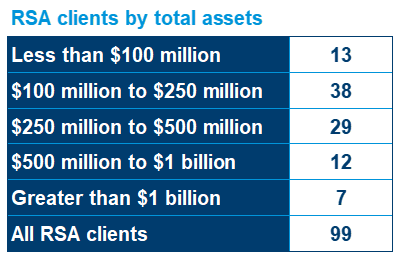
Clients frequently ask us, as a provider of interest rate risk reporting, how their results compare with those of other institutions. We compiled and analyzed the balance sheet structure and interest rate risk of our clients as of December 31, 2025. At the time of writing, we completed almost 100 risk sensitivity analyses (RSAs). We broke down the results by year-end asset size for comparison purposes.
Source: UMB Internal Data
Balance sheet composition
Loan growth, though moderate, continued through 2025. Investment portfolios experienced a significant reduction in unrealized losses, though they remain elevated. In their most recent Quarterly Banking Profile‡, the FDIC stated the industry’s unrealized losses reached their lowest level since the first quarter of 2022. The FDIC also reported community banks are allocating a smaller percentage of their balance sheets to longer-term loans and securities, a trend many UMB clients have also followed.
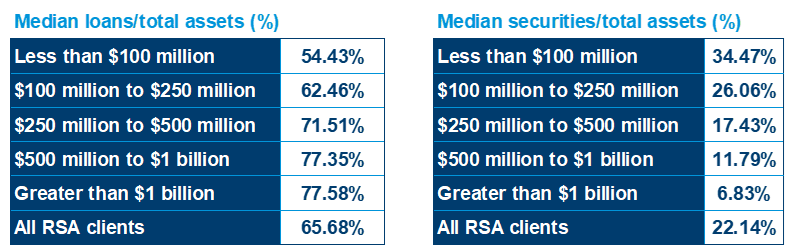
For UMB clients, the loans-to-total-assets ratio increased slightly compared to a year ago. All analyzed groups, except those with more than $1 billion in total assets, reported a higher loans-to-total-assets ratio. Institutions with more than $1 billion in total assets still hold the highest loan-to-total-assets ratio among all groups. Overall, the securities-to-total-assets ratio increased slightly, with clients holding $250 million or less in assets showing a higher ratio. Clients with total assets above $250 million saw the ratio decline.
Source: UMB Internal Data
On the liability side of the balance sheet, deposits grew over the year, but at a sluggish rate. In the fall of 2025, the OCC Semiannual Risk Perspective‡ stated deposit levels, net of brokered deposits, increased during the first half of 2025. Industry-wide, certificates of deposit (CDs) growth slowed significantly. CDs grew at unprecedented levels when the Fed raised rates, and institutions fought to hold onto deposits. S&P Global published a research article in December 2025‡ that noted that while community banks no longer rely on CDs for funding at the previous rate, CDs still make up a larger share of their deposit bases than pre-pandemic levels.
Earnings at risk simulations
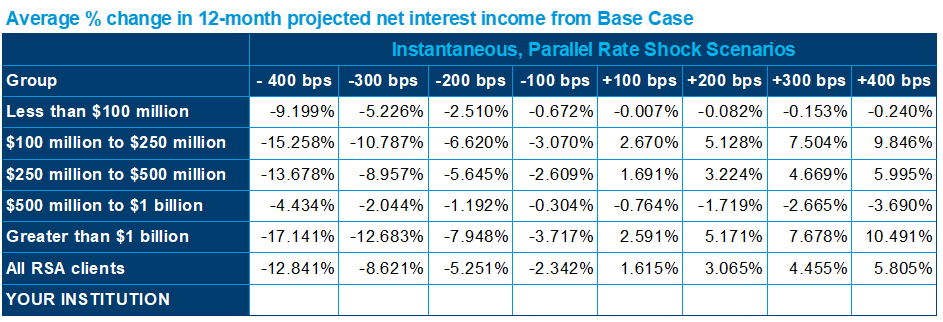
The earnings-at-risk simulations for UMB clients indicate—given the structure of their balance sheets as of December 31, 2025—most clients are likely to experience an increase in net interest income if market interest rates rise over the next 12 months, although results vary.
Over the past year, the modeled increases of earnings in the rising-rate scenarios climbed, likely because clients hold fewer long-term assets and maintain strong liquidity. In falling rate shocks, declines exceed the modeled increases in rising rate shocks because many liability yields quickly reach the natural 0% floor. Additionally, increased loan prepayments during falling rate shocks contribute to volatility.
Individual institutions may produce widely varying estimates, depending on the model’s underlying assumptions. In particular, betas (sensitivity factors) on non-maturity deposit accounts play a substantial role in shaping the perceived interest rate risk profile.
Source: UMB Internal Data
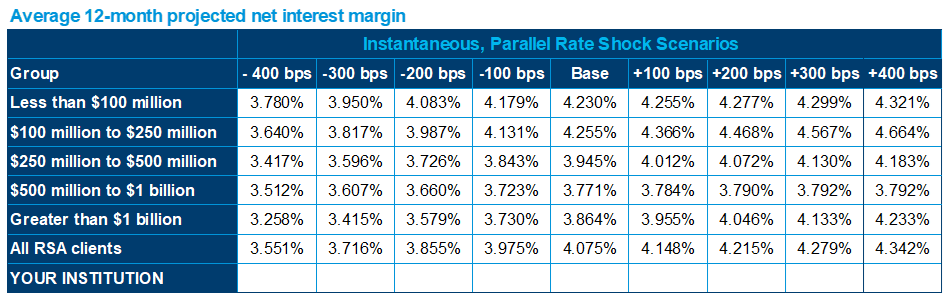
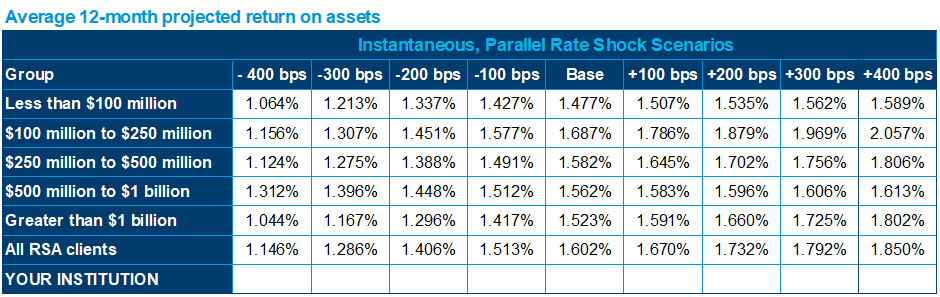
Industry-wide, net interest margins (NIMs) and return on assets (ROAs) continued to increase in 2025 as deposit costs peaked and, in some instances, began to decline. Asset yields continue to climb as lower-rate items mature off the balance sheet, and institutions replace them with higher-rate alternatives. Most of our RSA clients demonstrated this trend.
The average projected NIM increased 35 bps between December 2024 and December 2025 in the base case scenario. The projected return on assets increased by 14 bps for the same period. All RSA clients with December 2025 data reported base-case NIM and ROA of 4.075% and 1.602%, respectively.
Source: UMB Internal Data
Source: UMB Internal Data
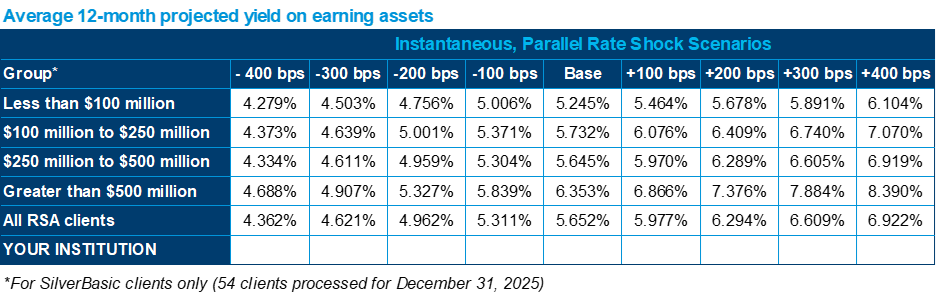
As mentioned, the higher projected net interest margin is driven by the higher projected yield on earning assets combined with the lower projected cost of funds. In the base case scenario, clients see a projected average yield on earning assets of 5.652%. This yield has continued to climb over the year as institutions replace longer-term fixed-rate assets that were on the balance sheet at lower rates with higher-yielding assets in the current rate environment. The projected yield on earning assets has climbed 26.1 bps from the 2024 year-end.
Source: UMB Internal Data
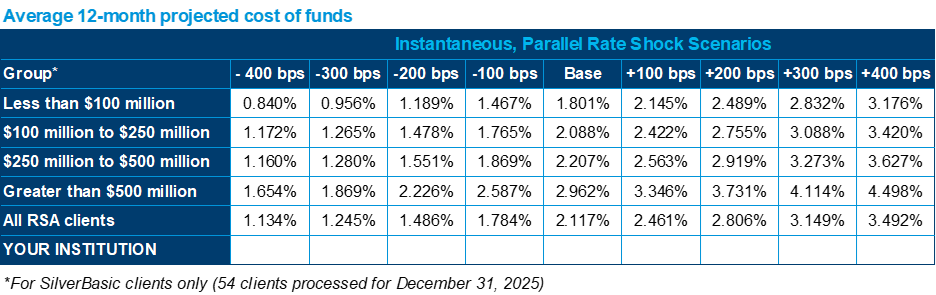
RSA clients’ projected cost of funds came in at 2.117% with December 2025 reporting. This figure decreased by 8.5 bps for the year, marking the first year-over-year reduction in the cost of funds since 2021.
Source: UMB Internal Data
Economic value of equity simulations
The following tables display the results of the economic value of equity (EVE) simulations we performed using December 31, 2025, data. Most banks maintained fairly stable EVE volatility, which measures long-term interest rate risk. Overall volatility declined slightly year over year, as banks shifted toward shorter assets, matching them more closely to the liability side of the balance sheet.
The falling-rate-shock results reveal abnormal trends because many balance sheet items still hit the natural 0% floor at various points during the rate shock. Leverage ratios (EVE ratios) increased over the year from already high levels. This aligns with industry-wide results, as the FDIC stated in its Quarterly Banking Profile‡. Financial institutions benefit from lower deposit rates not only from an earnings perspective but also from a valuation perspective.

Source: UMB Internal Data

Source: UMB Internal Data
What we expect in 2026
Strong and growing net interest margins in 2025 marked a welcome trend. In the S&P Global December research article previously referenced, the authors stated earnings growth should continue into the coming quarters. As credit costs rise, they expect growth to start moderating.
We also expect banks and credit unions to continue benefiting from an earnings perspective as we move into 2026. As assets continue to reprice higher in the current rate environment and deposit costs start declining with rate cuts flowing through to deposit rates, we expect NIM to continue expanding. A large portion of UMB clients see this reflected in the earnings projections we model. Net interest income continues to increase into year two and even year three of earnings projections if rates remain unchanged and interest rate risk remains stable.
If you have any questions or wish to discuss the results of this analysis in greater detail, please contact your UMB investment officer or financial services group analyst for more details. Learn how UMB Bank Capital Markets Division’s fixed income sales and trading solutions can support your bank or organization, or contact us to be connected with a team member.
When you click links marked with the “‡” symbol, you will leave UMB’s website and go to websites that are not controlled by or affiliated with UMB. We have provided these links for your convenience. However, we do not endorse or guarantee any products or services you may view on other sites. Other websites may not follow the same privacy policies and security procedures that UMB does, so please review their policies and procedures carefully.
Disclosure
This communication is provided for informational purposes only. UMB Bank, n.a. and UMB Financial Corporation are not liable for any errors, omissions, or misstatements. This is not an offer or solicitation for the purchase or sale of any financial instrument, nor a solicitation to participate in any trading strategy, nor an official confirmation of any transaction. The information is believed to be reliable, but we do not warrant its completeness or accuracy. Past performance is no indication of future results. The numbers cited are for illustrative purposes only. UMB Financial Corporation, its affiliates, and its employees are not in the business of providing tax or legal advice. Any materials or tax‐related statements are not intended or written to be used, and cannot be used or relied upon, by any such taxpayer for the purpose of avoiding tax penalties. Any such taxpayer should seek advice based on the taxpayer’s particular circumstances from an independent tax advisor. The opinions expressed herein are those of the author and do not necessarily represent the opinions of UMB Bank or UMB Financial Corporation.
Products, Services and Securities offered through UMB Bank, n.a. Capital Markets Division are:
NOT FDIC INSURED | MAY LOSE VALUE | NOT BANK GUARANTEED