Below is an economic analysis of August market moves provided by UMB Bank Trust & Investment Services.
August was marked by ongoing headlines regarding inflation data and consternation over the growing U.S. debt burden.
Inflation
Annualized inflation data continue to look “spicy,” coming in at 3.3% (core personal consumption expenditures – PCE). This was high enough to keep the futures market projecting at least one Federal Reserve (Fed) hike before year end. The monthly numbers are more encouraging, with June and July core PCE rising only 0.10% and 0.20%, implying a much milder annual rate of close to 2.00%. We need to see several months of monthly readings in this area before we presume that inflation is cooling, but recent numbers are encouraging.
Deficit and debt
Mid-month, news headlines were dominated by conversations of the Federal debt, which hit a new all-time high of $40 trillion.
The sheer magnitude of that number is upsetting to many, but it must be considered in relation to the overall U.S. economy and our level of interest rates. However, those analyses do not make the situation any easier to digest. The U.S. debt-to-GDP ratio is pushing to a new all-time high, as is the interest cost-to-GDP ratio.
Annual budget deficits have been large for more than a decade, and interest rates are rising, pushing our debt burden into potentially problematic territory. The Congressional Budget Office projects that deficits and debt burdens are likely to continue expanding over the next decade, pushing the U.S. deep into uncharted territory. While the U.S. is currently facing the most alarming debt statistics, many other countries in the developed world are not far behind the U.S. in this respect.
A thorough discussion of this topic requires much more space than is possible in this update, but the situation is likely to become problematic if current trends do not change. It is not an immediate threat to the smooth functioning of global financial systems, but it could become an issue in the years ahead. It is hoped that artificial intelligence (AI) will usher in a new era of strong GDP growth with lower inflation (and interest rates), which could dramatically reduce our debt burden ratios. Only time will tell if this fortuitous cycle comes to pass.
The Fed
The Fed held their annual Jackson Hole retreat: the first under Chairman Warsh. There was much trepidation leading up to his closing remarks, as he has, thus far, been extremely terse in his commentary. His comments at this event were slightly more generous, but were broadly interpreted as hawkish. He expressed skepticism of the recent softness of monthly inflation data, and reiterated that 2.00% inflation remains the Fed’s “firm, fixed target.”
Warsh appears to believe that underlying inflation trends are still too hot, and that the committee will hike rates if inflation data do not abate relatively soon.
Bond market and interest rates
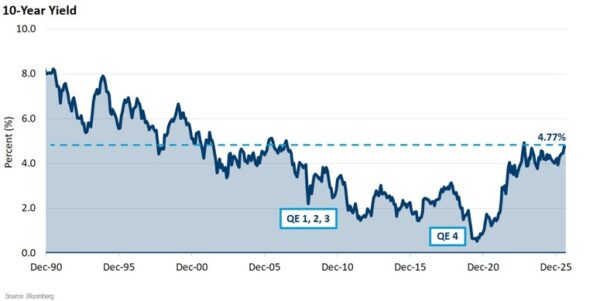
The bond markets responded quickly to Warsh’s comments. The 10-year treasury rate had been drifting lower during the month, but moved sharply higher at month-end, to a new cyclical high of 4.75%. Additionally, the futures markets shifted to indicate at least two (or more) rate hikes over the next year. These are not necessarily dramatic moves but signal a clear shift in sentiment due to Warsh’s comments.
It should be noted that U.S. rates have risen sharply—but they could be fairly characterized as having simply normalized back to the typical levels seen before the era of quantitative easing (QE)‡. These higher (perhaps normal) rates are putting pressure on the U.S. debt servicing burden.
Stock market
The S&P 500 generated powerful returns in the first two weeks of August, establishing a new all-time high on August 13. Lower oil prices provided the initial boost, then encouraging monthly inflation data provided a second burst of momentum. Stellar second-quarter earnings updates helped provide an overall sense of confidence for the broad market.
Mid-month, the narrative in Iran worsened and rates began to rise. The market spent the rest of the month digesting the challenges coming from rising rates. The month ended with a downturn due to the hawkish comments from the Fed meeting. Despite the challenging finish, the S&P posted a +2.72% total return for the month, with year-to-date (YTD) returns of more than 13%.
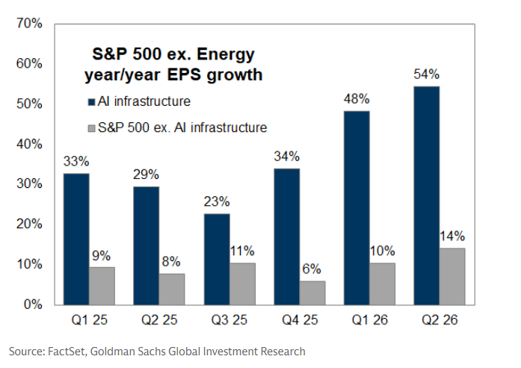
Earnings per share (EPS) growth is robust but continues to be driven by participants in the AI buildout.
Challenges ahead, but a steady outlook
As we turn toward year-end, the markets will have to contend with ongoing uncertainty on multiple fronts:
- The war with Iran
- The direction of inflation
- The reactions of the Fed
- The direction of interest rates
- The stock market’s ability to continue to generate historic earnings growth
The upcoming midterm elections are certain to ignite a media frenzy, but the markets have already adjusted to an expectation of a major shift in Congress in November.
The broad economy appears to be on stable footing, despite the elevated levels of uncertainty on so many fronts. It is widely forecasted that the U.S. will continue to deliver steady economic growth, at or slightly above our natural long-term growth rate of 2.0%. This is our base-case assumption and it should prove supportive of reasonable earnings growth and market returns into 2027.
The markets are well aware that the Fed may need to hike rates modestly over the next year and have built those moves into forward estimates. If inflation proves to be stubborn in the 3%+ range, forcing the Fed to move rates meaningfully higher, then estimates for economic growth and earnings will have to be adjusted lower, likely leading to a downshift in equity prices. This is not our base-case expectation, but it is the primary risk to the economic outlook.
We estimate the Fed will move rates higher once before year end and is likely to make one more upward adjustment in the first half of 2027. At that point, inflation should have moved sufficiently lower to allow the Fed to hold rates steady, perhaps turning their attention to lowering rates heading into 2028.
Summary and outlook
Inflation, the Fed and interest rates will continue to occupy center stage over coming months. Turbulence in Iran will likely grind on for the foreseeable future. Against this backdrop, we believe the economy will push forward at a steady pace very near 2.00%.
S&P 500 earnings will continue on the powerful trend coming from the AI buildout for at least the next 12 months. The rest of the market will enjoy more normal levels of earnings growth, in alignment with the steady hum of the overall economy. We believe the Fed will hike rates twice over the next 12 months, in alignment with current market expectations.
In summary, we foresee reasonable economic and market growth over the coming year. Inflation challenges pose the greatest risk to that forecast, but recent data are pointing in a promising direction. The election is sure to deliver high levels of histrionics from all directions. But we should be able to move past it, regardless of outcome, and prepare for a reasonably fruitful 2027.
For asset allocation, we are comfortable maintaining a modest overweight to domestic equities, given that we see a low probability of recession over the next 12 months (broad estimates place the probability at 20%).
We are here to provide our clients with peace of mind about their financial future. Anchoring to a sound, long-term financial plan will help you weather storms like these. We will remain disciplined, and consistent in our strategies and philosophies. We are confident that together we will manage our way through this (hopefully brief) challenging time.
When you click links marked with the “‡” symbol, you will leave UMB’s website and go to websites that are not controlled by or affiliated with UMB. We have provided these links for your convenience. However, we do not endorse or guarantee any products or services you may view on other sites. Other websites may not follow the same privacy policies and security procedures that UMB does, so please review their policies and procedures carefully.
Disclosure and Important Considerations
This report is provided by UMB Trust & Investment Services, a division of UMB Bank, n.a., for informational purposes only and contains no investment advice or recommendations to buy or sell any specific securities. Statements and projections in this report are based on the information provided by the client or third parties, and available as of the date this report was published. UMB Trust & Investment Services obtained information used in this report from third-party sources it believes to be reliable, but this information is not necessarily comprehensive, and UMB Trust & Investment Services does not guarantee that it is accurate. All investments involve risk, including the uncertainty of dividends, rates of return and yield and the possible loss of principal. Past performance is no guarantee of future results.
The S&P 500 Index is unmanaged, consisting of a market capitalization-weighted index of 500 common stocks. It is not possible to invest directly in an index.
You should not use this report as a substitute for your own judgment, and you should consult with professional advisors before making any tax, legal, financial planning or investment decisions. This report contains no investment recommendations, and you should not interpret the statements in this report as investment, tax, legal, or financial planning advice.
Neither UMB Trust & Investment Services nor its affiliates, directors, officers, employees or agents accepts any liability for any loss or damage arising out of your use of all or any part of this report.
“UMB” — Reg. U.S. Pat. & Tm. Off. Copyright © 2026. UMB Financial Corporation. All Rights Reserved
Securities offered through UMB Private Wealth Management, LLC (UMBPWM), an SEC registered investment adviser, UMB Financial Services, Inc. (UMBFSI), member FINRA, SIPC, a broker dealer and SEC registered investment adviser, UMB Trust & Investment Services, a division within UMB Bank, n.a., and UMB Bank, n.a. Capital Markets Division, a separately identifiable division of UMB Bank, n.a. and an SEC registered municipal securities dealer.
Banking services offered through UMB Bank, n.a.
Insurance products offered through UMB Insurance, Inc.
UMBPWM, UMBFSI, UMB Bank and UMB Insurance are affiliates and wholly owned subsidiaries of UMB Financial Corporation.
You may not have an account with all of these entities. Contact your UMB representative if you have any questions.